The Projects listed here are typically suitable for BSc and MSc students. They may contain experimental and/or numerical challenges; these aspects can be varied as needed and desired. There are no fixed beginning or end dates for these projects. We also collaborate with private sector or international colleagues who are often happy to host students for a related or different project.
Creep in Hydrogel Packings
Supervisors: Tommaso Pettinari, Edan Lerner and Joshua Dijksman
Most materials such as plastics and even rocks display “creep”: very slow flow or deformation under constant force, such as gravity. Creep is visible in geophysics, metals, and the slow degradation of most plastic consumer products. Despite its ubiquity, the fundamental reasons why creep exists are not understood. In this project, we study a model system in which we recently discovered that creep can be both reproducible measured as well as controlled, both of which are crucial novelties that should allow for a better understanding of creep. We probe the sinking or rising of a spherical intruder in a packing of submersed soft hydrogel spheres (think Orbeez). We combine such measurements with even more carefully controlled rheometry studies and flow field imaging using laser sheets and image analysis. The main aim is to find out which microscopic mechanical fluctuations affect macroscopic slow flows.
This project can be carried out using numerical simulations, e.g. using LAMMPS, or in the lab!
Computational and Experimental Subatomic Particle Physics in Fluids
Supervisors: Oussama Hajj, Clara Nellist and Joshua Dijksman
Become a Giant in Geant: in this project, we use the standard simulation package for subatomic particle physics called Geant4. The new thing is that we will use it to study fundamental fluid dynamics. The package Geant4 can calculate the radiative effects of pretty much all humanly known radiative processes and is used in medical physics, radiation physics and research at CERN. We are currently using it to do simulations on radioactive fluid tracers. We will use the package for experimental design optimization, data analysis and Machine Learning (ML) training of actual PEPT experiments that we will run in Birmingham University.
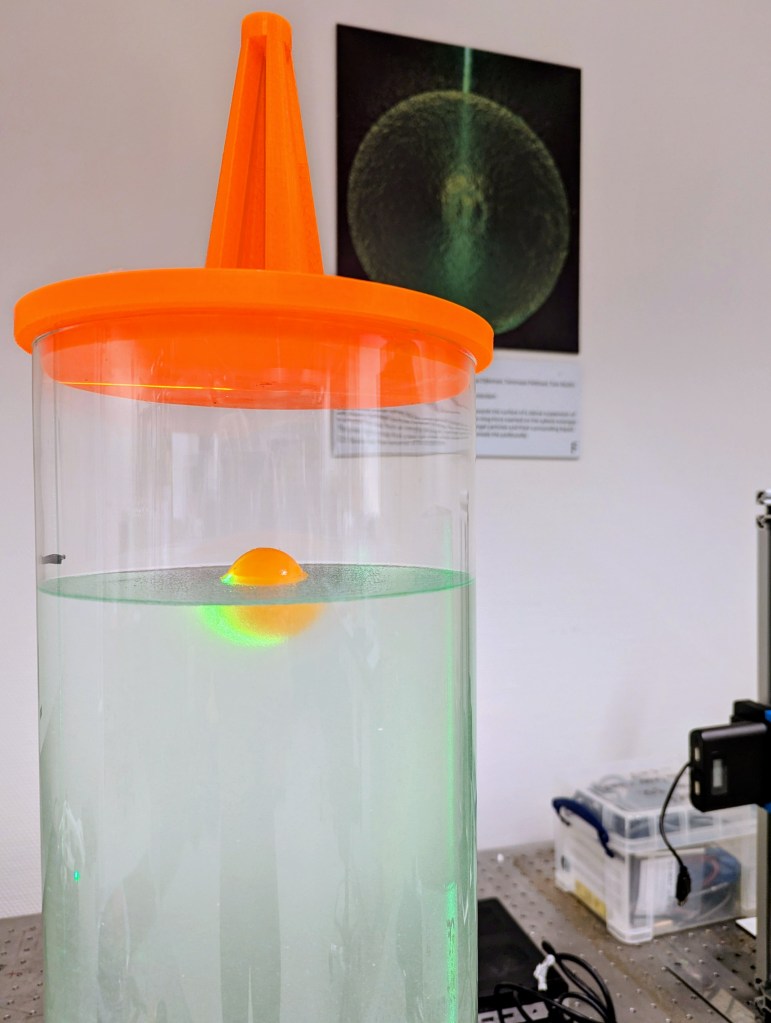
Note that this project also has an experimental component, in which you can develop an acoustic levitator or a spray generator for positron emission tomography. The special thing is that project is done under supervision of Clara Nellist from NIKHEF and Joshua Dijksman in the Soft Matter department in IoP. You will work together with Oussama Hajj, who is already well versed in the computational methods. Together, you will develop Geant4 in new ways, allowing it to be used for fluid dynamics applications. The code requires some skills in C++ but you can also focus on developing (ML) output analysis scripts in e.g. Python – we are flexible in the choice of focus. You can participate in activities in both the NIKHEF group, and/or the Soft Matter group, as you prefer.
Measuring odd viscosity of a chirally colliding gas
Supervisors: Ruben Lier, Corentin Coulais and Joshua Dijksman
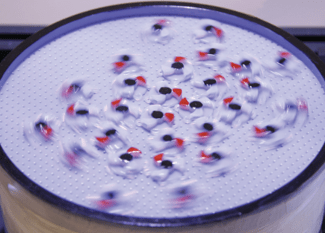
The goal of the project is to measure the fluid properties of a two-dimensional gas of chiral particles. Of particular interest is odd viscosity, also known as Hall viscosity, which is a transport coefficient that can arise in two dimensions when parity and time-reversal symmetry is broken. This symmetry breaking occurs for charged particles in a magnetic field, but also for chiral particles. Experimental evidence for the latter has so far been obtained in a colloidal suspension. In such systems the particles continuously exchange momentum with the solvent, meaning that momentum conservation applies only to the combined particle–solvent system rather than to the particle fluid alone. This complicates the interpretation of the resulting transport coefficients as intrinsic properties of a momentum-conserving fluid. To circumvent this issue, the project will involve the creation of a gas of chirally interacting particles on an air table, following a previously demonstrated approach. Once this gas is constructed, its fluid properties, such as odd viscosity, will be inferred. These properties can then be compared to the quantitative microscopic predictions of this work. It is already known from the previous air table experiment that this chiral gas displays a Maxwell-Boltzmann distribution in equilibrium, consistent with the microscopic model.
Tuning Fork Microscopy
Supervisor: Joshua Dijksman, Daniel Bonn
Why are the dishes slippery when you just use a soapy solution to wash them? The contact mechanics of lubricated (wet) contacts on soft (rubber glove) contacts are still mysterious. The so-called “tuning-fork” contact probe (or “MicroMegaScope”) has emerged as a potent experimental technique that can shed light on such complex physics. The tuning-fork microscopy consists of a tuning-fork that is driven by a piezo-electric actuator. By precisely monitoring the resonance frequency of the tuning fork when it touches another object, much information can be extracted from the nature of the contact. In this project, we aim to use this tuning fork technique to learn more about lubricated contacts on soft substrates such as hydrogels. We will use advanced electronics and modeling to learn more about the mechanics of lubricated contacts, the role of surfactant molecules in these dynamics, and the role of substrate elasticity.
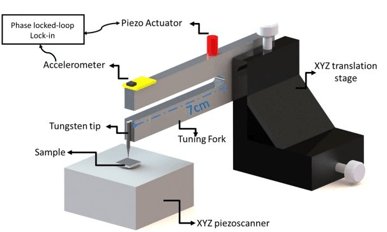
Taken from Canale et al 2018 Nanotechnology 29 355501

